One week down!
We are starting to settle in here in Makuhari, all have moved in with their homestay families and classes have begun. Leading up to now, we've done quite a few fun group activities involving trips to different areas of Tokyo.
Wednesday was spent mostly at the airport. Anne came first a little bit early so she, Dorsey-sensei, and I kind of wandered around Narita until the rest of the lot came. During that time we noticed that there were a bunch of TV crew looking people walking around so we strategically placed ourselves in various spots of the airport (upon Sensei's request) until they came over to us and asked us why we had come to Japan. The program was called "Youは何しに日本へ?" or, "What did you come to Japan to do?" and it apparently airs on Mondays at six or so. Still a little questionable. So we were interviewed by one group, then we went to sit down until Sensei realized that there was another crew in the same wing and so Anne and I walked with him to the opposite end of the wing to wait and "look foreign" until that crew came up and interviewed us as well.
So there was that.
Then everyone came, we all got on a bus to the hotel, arrived, checked in, and went to dinner with Yukari-san at this all-you-can-eat Chinese restaurant on the 41st or 42nd floor of the hotel. The food was great and the people who worked there were really nice and accomodating. It seemed to be that you needed a reservation in order to eat there, so they were hesitant at first, but then a different manager came out and showed us to our table. After dinner we went to take identification photos for our student ID's and then came back and had a well-deserved rest.
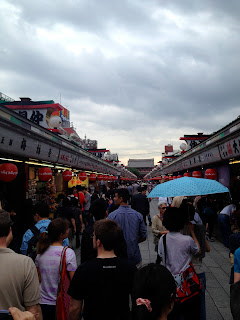
Thursday morning we got up bright and early and explored Tokyo a bit. We started at Asakusa with Sensoji Temple. It was raining a little bit, but still pleasant. Once we arrived, Dorsey-sensei so kindly gave us a short history lesson about the Temple and then we walked through the market-like street, passing different shops selling an array of foods, trinkets, and souvenirs, etc. We continued walking until we got to the entrance of the temple and the area where you are traditionally supposed to purify yourself before you enter. There's a fountain-like stone, water-filled structure covered by a roof where you take a wooden ladle in your right handle, pour the purifying water over your left, then switch. You can also put some in your mouth and then spit it out, but I think people don't really do that anymore as it's not that sanitary...
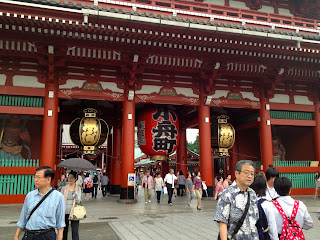

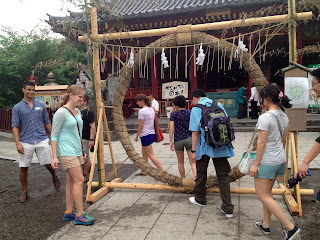
We then entered and looked around inside the temple for a while. Everyone tossed a coin into the designated space in front of the temple and said a prayer, as is tradition, and then moved to the side and pulled fortunes! Luckily for me, you're allowed to tie your fortune to this stand nearby if you get a bad one, leaving it to the gods of the temple to take care of. After we took care of our fortunes we walked to the Shinto shrine next door. In order to get to the actual shrine part, you have to go through this loop thing in a certain way (that was conveniently written on a sign next to it). So we walked through the loop, around to the left, and back to start; through, around to the right, and back to start; once more through, around to the left, and back to start; then finally straight through. Then there was some more praying and we continued on to Ueno.


This next photo is of Dorsey-sensei with a statue of a golden kappa, a water creature from Japanese folklore. We found this little treasure in Kappabashi-dori which incidentally makes the amazingly realistic plastic food you find in the front of stores. We made a stop here on the way to Ueno and this picture is amusing, so I thought I'd include it:
Anyway, after Kappabashi-dori we went to Ueno (which used to be the place where people from the country or poorer families etc would come to get work) and visited a street called Ameyokocho. There is some debate regarding the name of this street because the first two characters "Ame"
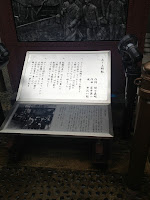
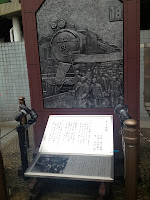
(アメ)can be interpreted in two different ways. The first is the first part of the word "America" which is possible because of the amount of knock off stores around. Dorsey-sensei made a point to warn us that if we somehow found a $15 Rolex, it probably wasn't actually a Rolex. The second is the word "Ame" (飴) meaning candy. The rest of the name, "yokocho", means alley or sidestreet. So Sensei let us loose around here and we all had ramen and did some exploring of the shops. Afterward we met back up at the station and took a look at a statue with the lyrics of Izawa Hachiro's song "Aa, Ueno Eki" written on it which basically portrays the singer's love for Ueno Station and the nostalgia that comes along with it. Either before or after the statue we went to the historical statue of Saigo no Takamori next to Ueno Park and then visited a Shitamachi Museum that, on the first floor was filled with replicas of a tenement and a merchant's house and on the second with toys, dolls, games, and other exhibits.
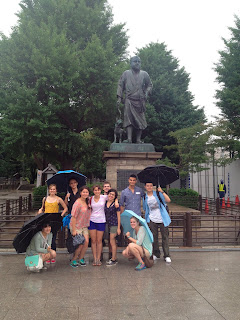
We then made the journey home and stopped for karaoke before dinner. Here's a commemorative karaoke photo:

Friday.
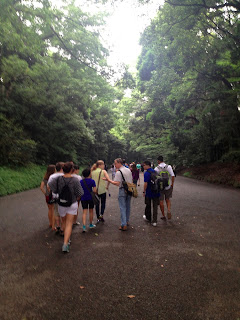
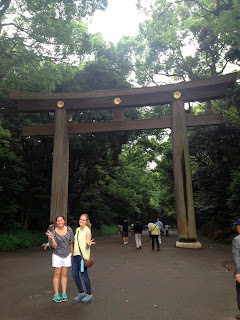
On Friday we started out at Meijijingu Temple. We walked around and through the beautiful temple grounds and came out at the street facing the 1964 National Olympic Stadium. There seemed to be no way for us to get into the stadium itself, but we got a good look at the outside through some trees and cars, etc.
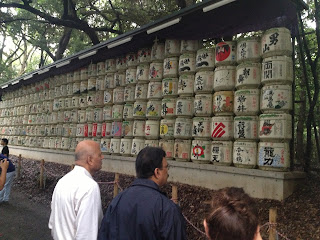
After that we looped back around to Harajuku and Takeshita-dori (dori means street) which is usually packed with tourists and high school students. There are a lot of shops and it's rather known for the funky Japanese street fashion that has kind of drifted over to the US and other countries.

So Dorsey-sensei let us loose and our aim was to get to the end of the street and find a building that was designed by a famous architect but we got distracted by stores and then didn't go far enough over to the right so we ended up almost where we started. But luckily, we met Dorsey-sensei by chance and he was able to lead us in the correct direction. Sadly, in said building they did not allow photos so I have documentation of that.
Afterward, as we were making our way to the station, we came by another place that Sensei had mentioned, the Oriental Bazaar, and got to shop around in there a bit. They stock an incredible amount of things that are stereotypically asian looking (specifically, Japanese) such as swords, yukata (summer kimono), tea sets, and the like.

We then traipsed through the rain, back to the station and moved on to Akihabara, partially to get denshi jishos for those who wanted them and partially to check out some of the otaku culture for those who had the desire (otaku is a word that is close to "nerdy" but really means someone who is an anime/manga enthusiast). We ate as a group at a family restaurant called Gusto and then split up to look around. Once we all met up again, we made the trip back, took a small break at the hotel and met for dinner at the Green Tower Hotel Makuhari with three Dartmouth alumns.
Saturday we had a reception with our host families and then went our separate ways with them. Then began the first week of classes and getting used to the swing of things in good ol' Chiba and at Kanda. Seems to be that everyone is getting the hang of things quite fast. :)


